
£27 million of NHS money paid to private hospitals by Kent and Medway CCG over just six months (Jan-June 2022)

An analysis of data published by Kent and Medway CCG (now ICS*), shows that a total of £27,045,394 was spent on ten private hospital companies in the first six months of this year.
Local NHS organisations are required by law to make public any invoices over the amount of £25,000. The monthly data is available to download here.
These figures do not even represent the whole NHS expenditure on private hospitals in the region – as it doesn’t include any invoices below the threshold of £25k, nor does it include expenditure by the four hospital trusts in Kent.
| KIMS | £6,631,452 |
| Spencer Private Hospitals | £5,365,849 |
| Spire Healthcare Ltd | £4,225,362 |
| BMI | £2,842,236 |
| Practice Plus Group Hospitals | £2,195,316 |
| One Ashford Healthcare Ltd | £2,022,452 |
| Benenden Hospital Trust | £1,461,353 |
| Circle | £1,187,891 |
| Healthshare Ltd | £767,495 |
| Nuffield Health Tunbridge Wells | £345,988 |
WHAT’S WRONG WITH THE NHS USING PRIVATE HOSPITALS?
Private hospitals use the same limited pool of staff as the NHS. The idea that private hospitals and clinics have extra ‘capacity’ that can supplement the NHS in times of difficulty is often repeated but untrue. The truth has been exposed but, frustratingly, the myth endures.
Private hospitals do not have any doctors. They rely on NHS staff working outside their NHS hours. Most private hospitals don’t employ medical staff at all, they use them on a self-employed basis, meaning they keep their labour costs low and make more profit (while the NHS picks up the tab for holiday pay, pensions, insurance and all the other expenses that a responsible employer must cover). The NHS also trains and assesses the UK’s medical workforce; the private sector does not, thus evading another expense which public funds cover.
It is a false economy to use the private sector, and in effect allows private interests to derive profit directly from resources that they did not contribute to build. The private health sector has a parasitic relationship with the NHS.
Not only this, but the fact that private hospitals use NHS medical staff actually depletes NHS capacity at a time when resources are spread dangerously thin. When a private hospital is awarded a contract to treat NHS patients, staff are diverted away from the NHS to work shifts in private hospitals, where they will often be undertaking elective surgery and less urgent cases. It allows NHS Trust execs to give the impression that backlogs are being cleared, but it will leave NHS hospitals understaffed and in effect diverts healthcare to the less urgent cases that can be treated in private settings. Using the private sector worsens staff shortages – which is the most pressing problem the NHS is facing.
The drive to use the private sector in the Covid aftermath was not about helping the NHS – it was about propping up the private sector after a pandemic-related slump in self-funding patients.
It is self-destructive for the NHS to farm out patient care to the private sector, but the policy is being dictated by government and even endorsed by the party in opposition. The alternative is to spend that public money on NHS facilities and staff, boosting the NHS instead of the organisations that feed off it and deplete it.
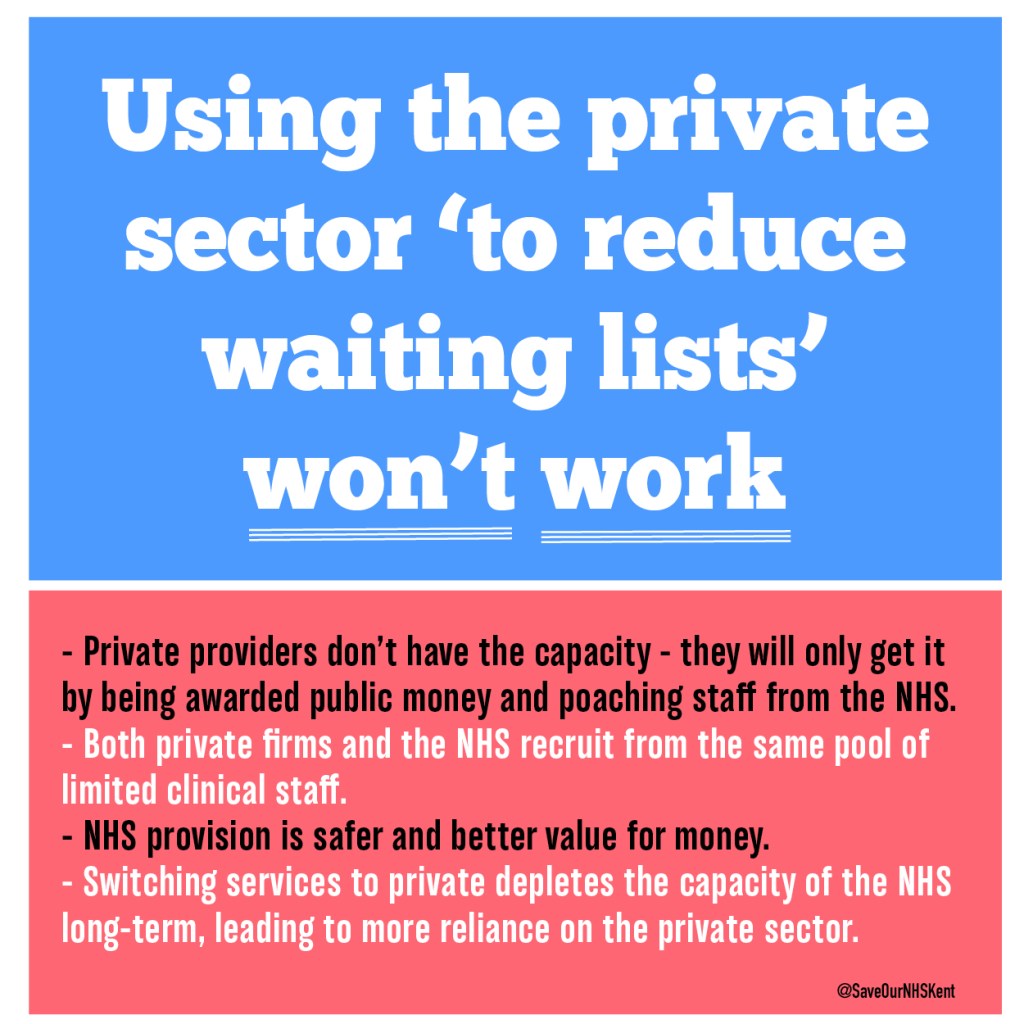
Private hospitals are thought by some to provide better care than the NHS, but this is not actually the case. Concerns were raised during 2021 that private hospitals took on more complex cases due to Covid pressures than they were used to, resulting in poor patient care. An inquiry was launched into the case of a cancer patient who died following care in a private hospital that was funded by the NHS.
The CHPI have produced reports outlining patient safety risks that arise in private hospital settings, and this File on 4 episode provides a good summary of the reasons why care can be less safe in private hospital settings.
Background on some of the private hospitals being paid by NHS Kent & Medway
KIMS HOSPITAL (KENT INSTITUTE FOR MEDICINE AND SURGERY)
The figures show that £6.6 million of NHS funds were paid to the KIMS Hospital based in Maidstone, a private hospital operator that reported a gross profit of £20.3 million last year and a profit margin of 51%.
Lyca Health acquired KIMS hospital in October 2021, which is part of the corporation Lyca Group which owns numerous companies that operate in different sectors – including Lyca Mobile, plus insurance and media companies and a travel agency.
A report by the Sunday Times Rich List team shows that Subaskaran Allirajah, the owner of Lyca Group, donated £614,300 to the Conservatives general election campaign in 2017.
KIMS Hospital also has links to Kent MP Craig Mackinlay. Mackinlay was paid £500 by KIMS for giving a speech at an event in October 2017. He is the Conservative MP for South Thanet, representing some of the most deprived constituents in the south east.
A report by CHPI in 2017 noted that KIMS was one of a number of private hospitals that have a high number of consultants contracted to carry out procedures but a low number of patients, meaning that they would “provide treatment in an unfamiliar environment where they were not used to the equipment and did not know the local policies” which led to accidents. A CQC report stated that “these consultants had an initial look around the premises but were unfamiliar with the policies and practices at [the hospital]. They would not necessarily be familiar with the equipment. This posed a risk to patient safety. We saw an incident report where a patient had suffered a burn as a result of a surgeon being unfamiliar with equipment.“
SPIRE HEALTHCARE
The Kent and Medway CCG spent over £4 million to Spire Healthcare in the first six months of this year. The CCG’s documents show the expenditure covered ‘acute commissioning’ and ‘planned care’.
In 2021, Spire made a profit of £87 million. Spire was part of the controversial block contract scheme set up by Sajid Javid to provide extra pandemic capacity which led to payments of 400 million a month despite being highly underused (as revealed by leaks, two thirds of the capacity was unused).
In mid-2020, the Competition and Markets Authority (CMA) fined Spire Healthcare and six ophthalmologists a total of over £1.2m for illegal price fixing at the Regency Hospital in Macclesfield. Spire Healthcare Ltd and Spire Healthcare Group plc were fined £1.2m while the six consultants received fines of between £642 and £3,859 after admitting they had agreed to fix self-pay fees for initial consultations at £200 over a two-year period.
In 2009 a patient died at a Spire hospital in Essex amid reports that staff had no life support training. The matter only came to light due to a whistleblower, who blamed organisational failings and said her warnings had been ignored. The patient had attended the hospital for routine bowel surgery.
BENENDEN HOSPITAL TRUST
Benenden Hospital is located in Cranbrook. It offers its own private health insurance scheme as well as taking self-pay patients. Its income from government contracts went from zero in 2017 to £7 million in 2019.
In 2014 it was reported that Benenden’s finance chief, James Gibbon, stole £1.2 million from the organisation to ‘fund his lavish lifestyle’. Gibbon pleaded guilty to the charges.
In 2017 a patient who had received vaginal mesh surgery at Benenden Hospital spoke out about her experience. Julie Knight said, “I was told I was lucky to be offered the surgery as it cost twice as much as traditional surgery.” When complications arose, she returned to the hospital for what she thought was corrective surgery, but a second piece of mesh was fitted by the surgeon. After that her problems worsened. She had the two implants removed at a different hospital in November 2016, with her surgeon describing the mesh as “hard, breaking up and curling up” inside her. She said “I was besides myself to learn that another piece of mesh had been inserted” by the surgeon at Benenden hospital.
CIRCLE, NUFFIELD, PRACTICE PLUS AND BMI
I’m including links to background information on some of the other private hospital firms here. Circle Health (the firm behind the notorious and disastrous attempt to privatise Hinchingbrooke Hospital in 2011); Nuffield Health; Practice Plus (the healthcare wing of Care UK, whose founder John Nash donated large sums to the Conservative party. He was also appointed to government roles by George Osborne and received a peerage in 2013); and BMI, which has had safety concerns raised about the care in its facilities. BMI is now owned by Circle Health.


 In Whose Interests?