A look at Labour’s ‘Stronger Together roadmap’
Labour Minister Anneliese Dodds surprised the nation last week by announcing that Labour had a set of policies laid out online that voters could refer to, saying ’if people are particularly interested they can look on the Labour website’. Her choice to refer viewers online rather than use BBC airtime to promote the party’s offering raised eyebrows, as did the fact that no policies initially appeared to be listed on Labour’s website.
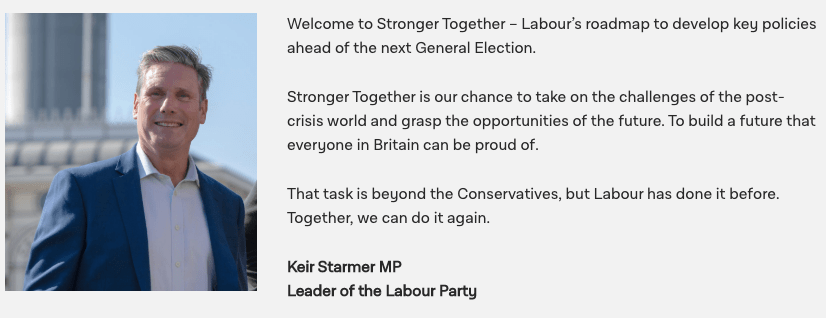
However, it emerged that she was referring to a less prominent subsection of the Labour party site labelled ‘Stronger Together – a better future for Britain’. The introduction explains that ‘Stronger Together’ is ‘Labour’s roadmap to develop key policies ahead of the next General Election.’
My main area of interest is healthcare and the NHS, so I examined the section on what the party is proposing for public services. Here is my analysis:
- What is provided on the pages of ‘Stronger Together’ cannot legitimately be referred to as ‘policy’, as what the statement (or ‘roadmap’) boils down to is very little, and what is said is far too vague to constitute policy. Despite the number of words on the page, when taken apart, there is very little of substance. It’s mostly a summing up of what is currently wrong and a handful of vague intentions – almost all in abstract form.
- There is extensive (and justified) criticism of Tory handling of the NHS, listing many of the failings, but notably no mention of privatisation. It does refer instead to outsourcing, and criticises outsourcing in terms of cronyism (ie contracts going to organisations with connections to Tory MPs and ministers). It does call for ‘an insourcing revolution’ but this has already been contradicted by Health Secretary Wes Streeting who committed to using private providers to ‘bring down waiting lists’ in January 2022, and has not reversed that position despite it being demonstrated that the method is unworkable and will deplete rather than boost the NHS’s capacity and performance.
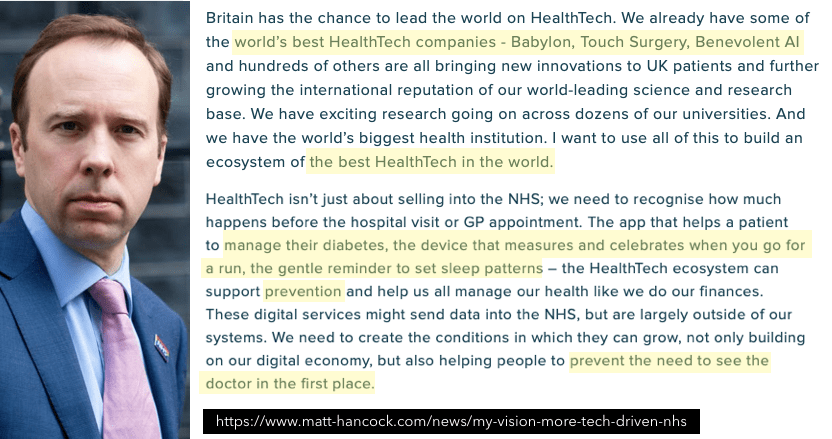
- It says the NHS and Social Care must be ‘world-class’, ‘prioritising prevention, early help and technology’. In language and content this matches exactly what the Tories have been pushing consistently under Hancock and Javid as their silver bullets for improving the NHS and social care. Prevention and tech could and should be good for health and care, but under the Tories it means reduction of services – taking funds away from frontline care and putting them into private biotech and AI firms (whose offerings are sometimes – but not always – little more than gimmicks). The NHS remains dangerously understaffed whilst the share prices of these private biotech and AI firms shoot up and gather more and more investor dollars. Prevention is crucial in health, but under the Tories it is a diversion away from government responsibility and associated with patient-blaming narratives. Care at home (social care) providers are almost entirely private, and the growth of this sector has been considerable in recent years. Social care firms do not offer free care, so only families with money to spare can afford it. The talk of ‘care at home’ and ‘innovative’ technology disguises the Tories’ neglect and gives them something optimistic sounding to say that suggests prestige and quality, but in reality is more about private provider profits and distraction. Tech, prevention and care at home could be different under a new government, but there’s nothing to suggest that in the Labour party’s statement, as there are no specific commitments and nothing that delineates how Labour would do things differently from the Conservatives. Labour’s prior policy of a National Care Service, offering free at the point of use personal care is conspicuous by its absence.
- Labour’s statement says the NHS should be ‘properly resourced’, but it doesn’t give specifics. Will Labour raise spending to a higher percentage of GDP as in 2009? Or to the higher health spend per capita seen in Nordic countries, Germany and Iceland? Will it commit to ensuring the NHS is publicly-funded, or that money goes to frontline services, where it is most needed? We don’t know.
- The most promising part of the statement is the item that sounds closest to a firm commitment: “With a stronger future for our public services, by 2030 we can launch an insourcing revolution”. This is not as reliable as the party’s prior promise to ‘reinstate the NHS as a public service’, nor is it a promise to end NHS privatisation in its various forms. What it means in practice is not explained, but it sounds like an intention to outsource less. Which is positive, and a step in the right direction – but it is a dilution of earlier promises. It is of course harder to hold a party to account when they promise ‘an insourcing revolution’ rather than, for example, a commitment to insource 85% of clinical services by a certain date, or to enact laws that make insourcing the default, or even compulsory. It is also a bit weak to ‘launch’ the changes by 2030, rather than committing to instigating the process for change at the earliest opportunity. ‘The biggest wave of bringing services in-house for a generation’ is promised, but given the sheer amount of services that have now been outsourced, a ‘biggest wave’ could actually be quite small – and wouldn’t automatically mean the majority reverts to being provided in-house. Then there is the question of what ‘insourcing’ means. It sounds like a commitment to return health services currently provided by private providers back inside the NHS, but the term ‘insourcing’ is often used to describe a new form of outsourcing where the work is undertaken by a private provider, but it is delivered inside NHS facilities and alongside NHS staff (see the ’18 Week Support’ section on this post for more detail).
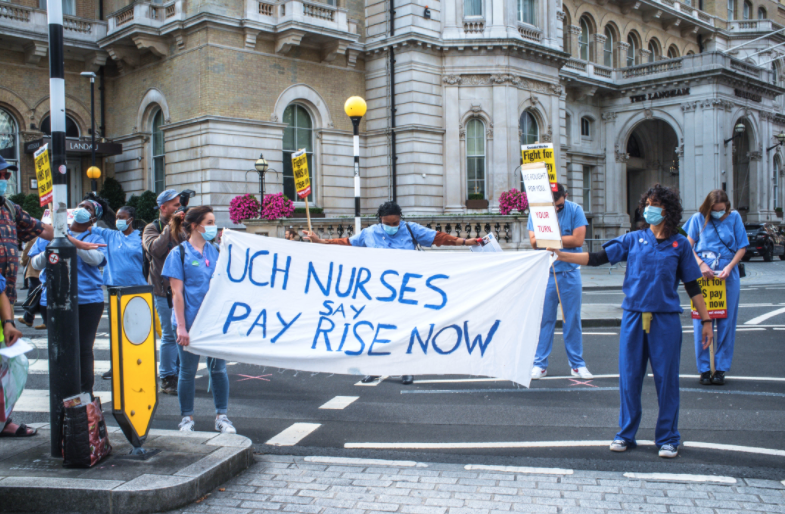
- Labour say they ‘want a country…[that will] value the key workers that deliver’ our public services. This is a hugely important element in preventing our public services from collapsing – if the workers feel valued, are paid fairly and have decent working conditions, the NHS and other services will attract the staff needed to rebuild from the dire situation we currently have. But this statement DOES NOT tell us if Labour will increase pay for NHS workers, many of whom are on lower pay in real terms than they were in 2010, and now facing the soaring cost of living. There are nurses on the lower end of the pay scale that are relying on food banks or missing meals. The majority of nurses (ie. those on band 5) are £3,000 a year worse off than they were a decade ago. This collection of nurses testimonies during Covid-19 tells of nurses who are too low paid to afford therapy to recover from the horror of the pandemic, and too low paid to have holidays. The standard of living for many NHS workers has been tumbling. Neither main party is offering a restorative pay rise. So no wonder NHS workers are leaving to work in supermarkets or the private sector. The understaffing in the NHS is the biggest threat to patient safety and the continuation of the service (a recent report claimed 75% of hospital shifts are understaffed). Under pressure from unions, NHS workers and campaigners for a restorative pay rise for nurses and other NHS workers in 2021, the Labour front bench failed to discuss anything above a 2.1% rise in pay (which would be immediately cancelled out by inflation and not make up for the 8 year pay freeze imposed by Jeremy Hunt) and Labour did not support workers’ calls for a 10% or 12% pay rise. Angela Rayner (speaking to Charlie Stayt on BBC Breakfast) would not even commit to a 5% pay rise (the sector was calling for 10%) and falsely claimed that the public would not support a 5% pay rise, despite polls showing that a majority actually supported 10%. Signs so far suggest Starmer’s Labour are unwilling to redress the NHS pay injustice. Low rates of pay in the NHS is one of the big drivers boosting the expansion of private health in the UK – the more staff that defect to the private sector, the more NHS contracts the private sector will win. Many believe the Conservatives stifle NHS pay for this reason. Labour are wrong to hide from this burning issue.

- The roadmap says ‘we need to turn the tide on rising health inequalities’, which is 100% correct and a very commendable opinion – but that’s all it is, an opinion, unless the party commit to specific targets or actions. The same applies to this viewpoint on mental health: ‘everyone should be able to access the mental health services they need’. Who wouldn’t agree? But it doesn’t even say that the services should be provided free, let alone describe what actions we can expect from Labour to get there.

In the 2019 general election, voters cited the NHS as the policy area they cared about most (with Brexit second). So why is it that Labour is so reluctant to share it’s policies on this fundamentally important area?
Labour’s manifestos in 2017 and 2019 were packed with policies that would end the damage done by years of Conservative cuts, reorgs, privatisation and misery doled out to staff. In 2019 a 4.3% real terms annual increase in the health budget was promised; this would have seen spending on health services increase at a faster rate than the average for most previous governments over the NHS’ history. Public health cuts were to be reversed; the use of private providers and PFI were to be ended and the Health and Social Care Act repealed – all policies that delighted health campaigners who understand how important the legal structures are in preventing a private takeover of the NHS. The policies were popular with the public too, with 48% supporting the ending of private sector provision in the NHS and 83% supporting free personal care for the elderly.
Is it time for Labour to free themselves from the private health money that’s been funding them in the last two years and present an inspiring anti-privatisation, anti-cuts and pro-worker Labour NHS plan?
We can but hope.
By Carly Jeffrey, June 14 2022.

Further reading:
Why Red Wall voters are right about public ownership
Ten reasons why privatisation is bad for you
If you believe in a public NHS, the health and care bill should set off alarm bells


 In Whose Interests?