
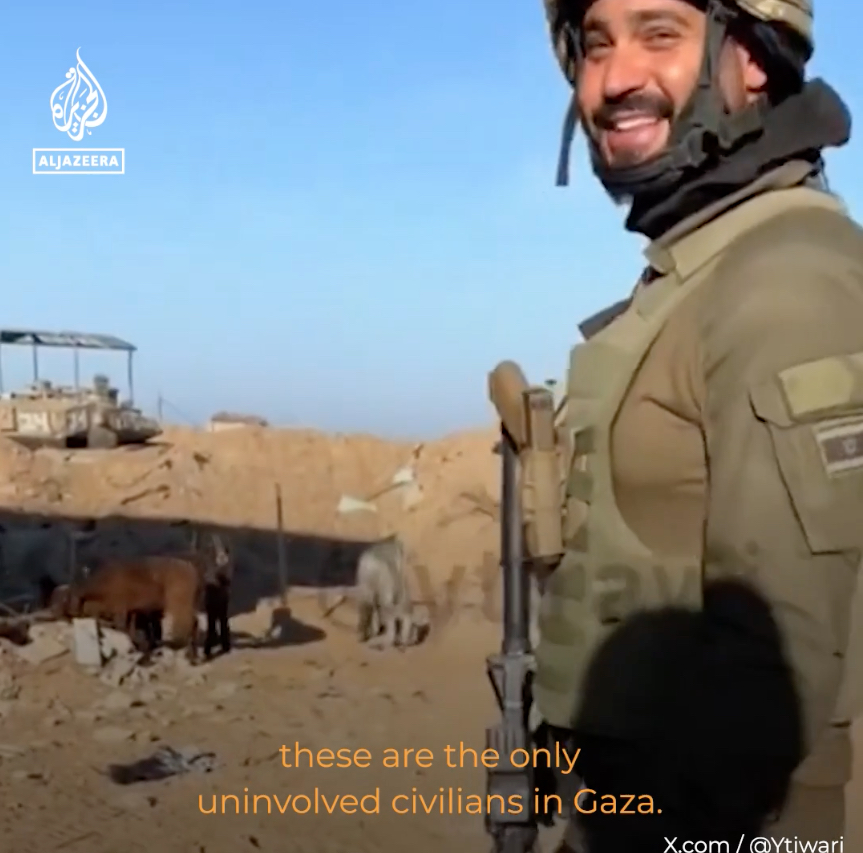
Israeli soldiers photographed with the underwear of Palestinian women in Gaza
The mass slaughter and starvation of Palestinians by Israel continues, with Lebanese civilians also now being murdered and maimed. Meanwhile, the West continues to fund, arm and provide diplomatic cover for the genocidal Israeli state.
This week, I simply want to highlight some of the writers and thinkers who are covering this painful anniversary in a way that deserves to be heard.
1) Naomi Klein’s article ‘How Israel has made trauma a weapon of war‘ in the Guardian (Sat 5th October 2024). Klein’s thought-provoking piece tackles the proliferation of memorialising phenomena of the the events of October 7th, many of which intend to be ‘immersive’ and to actually create/recreate trauma in the viewer. “Consumers of these experiences are encouraged to feel a distilled bond with the victims, who are the essence of good, and a distilled hatred for their aggressors, who are the essence of evil. The traumatized state is pure feeling, pure reaction. Vision is narrowed, tunneled.” We lean that Israel will be spending $86m on future memorialisation projects, whilst “many of the families of people killed or taken hostage on that day have come out forcefully against” the Israeli’s government’s large televised memorial event. Klein talks of re-traumatisation passing for commemoration, of the Palestinians and Lebanese whose funerals are not safe from Israeli attacks, that they do not have the luxury of ‘bearing witness’ from a place of safety, and reminds us that “sometimes witnessing is itself a form of denial, marshalled by savvy states to form the justification for other, far greater atrocities”.
2) Ghassan Hage’s essay GAZA AND THE COMING AGE OF THE ‘WARRIOR’. This is not about the anniversary, in fact it was written in November 2023. But Hage’s important dissection of the features of the ‘supremacist mourning’, permeated with vengeance and exceptionalism, is required as we experience a new cycle of one-sided depictions of the last year. In Hage’s words, “as the Israeli massacre of Palestinians began to quickly overshadow Hamas’ massacre in its scale and in its racist de-valorisation of those being killed, it became clear that this was no ordinary mourning of the dead. This was a supremacist mourning: the world was invited to accept that, unlike Palestinians who are murdered all the time, the murdered Israelis were special. They were superior dead people who needed to be revenged in a way that reminds everyone, but particularly the killers, of how superior they were. Anything less was “anti-Semitism.””
3) Sondos Sabra’s ‘Letter from Gaza: a year of devastation‘, The New Statesman (7.7.24). This piece is in the form of diary entries written by Sabra, who works providing psychological support to children in Gaza City. “This war has exhausted us, drained us, worn us down. We have suffered greatly. We are mentally and physically drained. We are oppressed in our own land, counting the days and misnaming them.”
Sabra writes, “today, “terrorism” was hiding in the body of Omar, my six-year-old nephew – perhaps in his heart, or among his soft locks of hair – so they killed him. They dropped two missiles on him and his siblings, Aya and Ahmad, and his niece Sila, who was only six months old, killing them all. Perhaps terrorism hides, too, in a garden, in the warmth of a home, in the bells of a church, in the minaret of a mosque, between the pages of books, even amid the tents of the displaced.”
Sabra’s writing encompasses the many varieties of suffering and death faced daily in Gaza, but also celebrates life, beginning with a beautiful description of the “jad alzatoon” season, when Gazan families “gather to pick olives in an atmosphere of cooperation and joy”.
4) Qassam Muaddi’s Israel’s year of war on the West Bank published in Mondoweiss (7.7.24). This article covers the violent attacks on Palestinians by settlers, and how this they in with the actions of the government and military. “Observers argue that Israel’s strategy in the West Bank after October 7 has aimed to create a new political reality, heading towards achieving definitive Israeli control over the West Bank.”
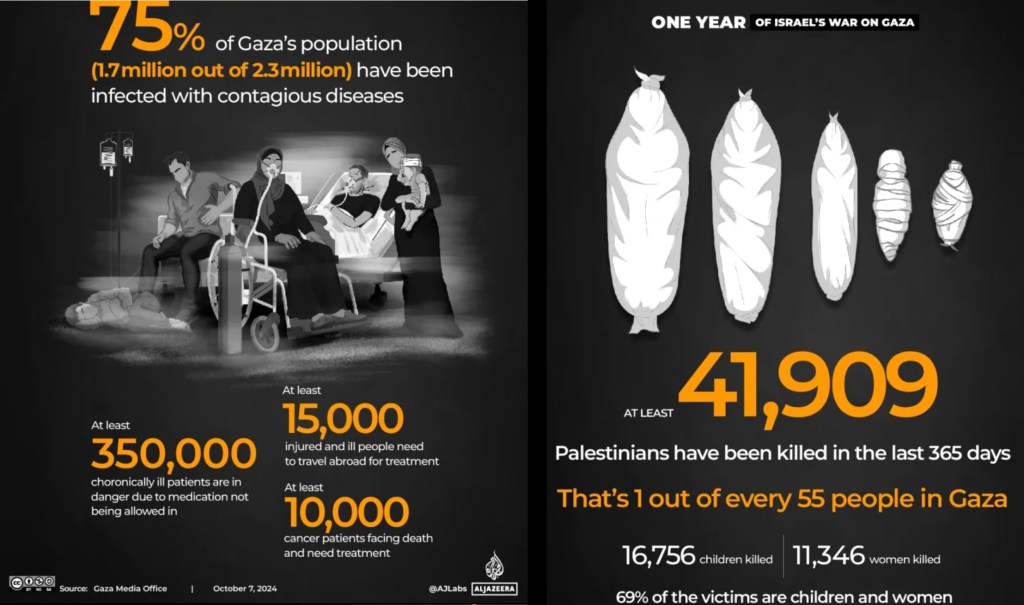
5) Al Jazeera’s One Year of Israel’s War on Gaza focusses on the numbers, including: 41,909 Palestinians killed; 97,303 injured; more than 10,000 missing or accounted for; 114 hospitals or clinics rendered inoperative; 75% of Gaza’s population infected with contagious diseases; 96% facing a lack of food; 700 water wells destroyed, and over 10,000 Palestinians held in Israeli prisons in dangerous conditions, with 3,332 of those being held under administrative detention, i.e., without charge or trial.
6) Yanis Varoufakis reflects on one year of genocide in Gaza (Frank Barat Youtube channel, 2.10.24). Topics covered include the recent Israeli Knesset vote against a Palestinian state, non-violent resistance in the form of BDS (boycott, divestment, sanctions), the role of the USA in perpetuating Israeli aggression, genocide tourism, and Zionism: ‘being a Zionist means to accept, to embrace the white settler’s dictum ‘a land for a people for a people without a land’… the British when they went to Australia, upon arrival they found 5 million aborigines there, but immediately for legal purposes, they declared it terra nullius, a land without a people. That’s the beginning of genocide.”
All I can say today is that this carnage could be stopped if the USA halted its regular supply of weapons, billions of dollars and moral justifications for Israel’s aggression, occupation and war crimes. The West must stop supporting Israel and sever all ties with the rogue state until it stops the murder, starvation, administrative detentions, torture, occupation, apartheid and lies.
If you'd like to suggest other pieces that provide an honest and just perspective on this disgraceful anniversary - one that marks a year of the collusion of so-called liberal democracies in mass child slaughter - please do so in the comments.
#StopArmingIsrael #EndIsraeliImpunity
8th October, 2024.

 In Whose Interests?